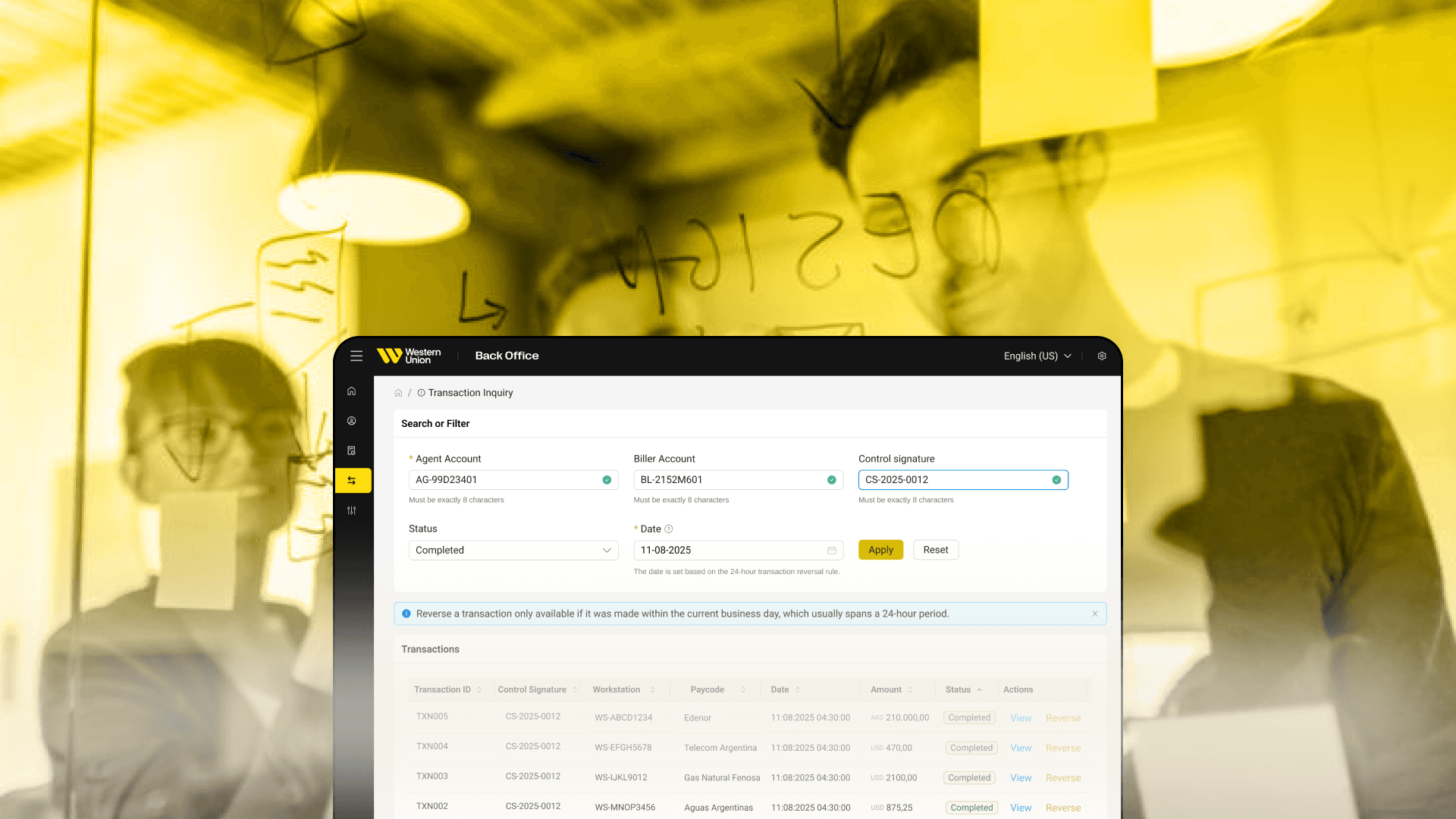
The Challenge
In a high-stakes financial environment like Western Union’s Back Office, "good design" isn't just about aesthetics; it’s about absolute precision. While working on the Back Office Product, I realized that my traditional "design-first" approach was no enough.
The Pivot: From "Designing a Prototype" to "Building for Value"
I presented a new framework to my cross-functional team of developers, designers, and engineers. My goal was to move us away from the "Prototyping Starter Pack" of the past and toward a Build Thinking Mindset.
1. Redefining High-Fidelity (The Intentional Fidelity Framework)
I stopped treating the prototype as a final delivery and started treating it as a Living Spec. Using tools like v0, Lovable, and Bolt, I shifted the focus from how a screen looks to how it behaves.
Visual Fidelity: Branding and typography.
Behavioral Fidelity: Real navigation and state transitions.
Data Fidelity: Using real system results rather than "Lorem Ipsum" to find actual logic errors.
2. Building to Learn vs. Building to Earn
The most critical shift was an honest assessment of our goals:
Building to Learn: In early stages, we optimized for discovery and evidence, tolerating errors to "fail fast".
Building to Earn: As we moved toward the Reversal Flow, I shifted into a "delivery" mindset. We could no longer ignore the "messy" parts of the product. This meant obsessing over edge cases, error handling, and security—the 90% of the work that static designs often hide.
3. Killing the "Functional Illusion"
I challenged my team to be critical of our own demos. A prototype that works in a controlled environment is an illusion of progress. By acknowledging the enormous distance between a prototype and a production-ready product (telemetry, scale, maintainability), we were able to have much more honest and productive conversations during handoffs.
4. The Prototype as a "Living Spec" & Documentation Hub
I shifted the focus from how a screen looks to how it governs the project. To ensure alignment across all disciplines, I customized the functional prototype to include:
Integrated Test Case Documentation: We embedded specific QA scenarios directly into the flow, allowing engineers to validate logic in real-time.
Onboarding Scenarios: Tailored walkthroughs designed for different users and teams, ensuring everyone understood the "why" behind the complex reversal rules.
Live Guidelines: Instead of static PDFs, we used the prototype to house interaction guidelines that evolved alongside the code.
The Outcome
By adopting Build Thinking, the team moved away from the search for a "Sacred Prompt" or a magic shortcut. We embraced a process of continuous iteration.
The result wasn't just a better-looking UI; it was a Search & Reversal logic that was technically sound, business-viable, and ready for the rigors of production.
Reflection: This project taught me that the most valuable thing a designer can build isn't a pixel-perfect screen—it’s a shared language of discovery that bridges the gap between a vision and a working product.